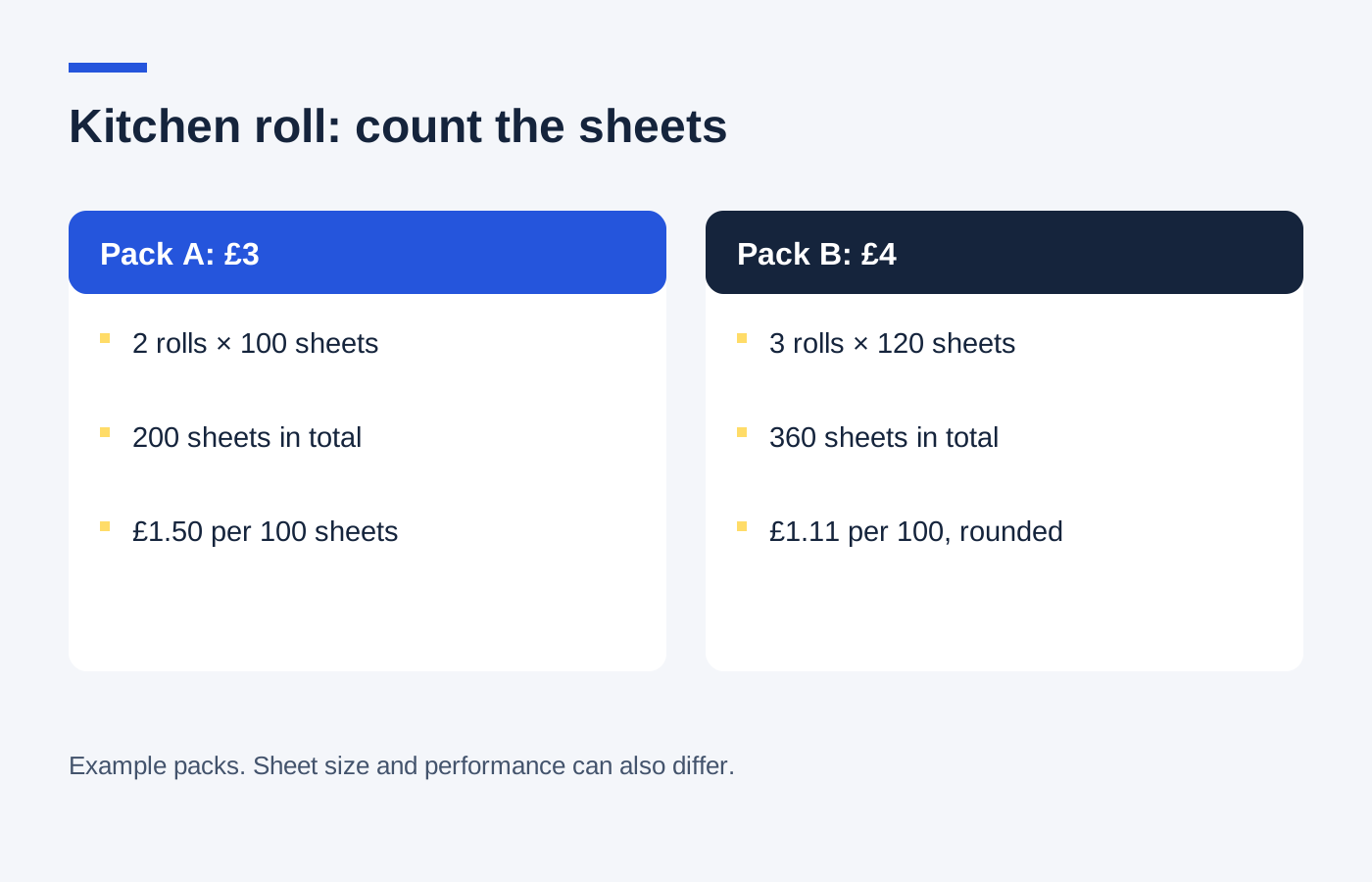
Multiply rolls by sheets
In a fictional comparison, Pack A contains nine rolls of 200 sheets at £4.50. That is 1,800 sheets, costing 25p per 100 sheets. Pack B contains twelve rolls of 150 sheets at £4.80. It also contains 1,800 sheets but costs about 26.7p per 100. Pack A is cheaper for the same sheet count despite having fewer rolls.
Use the shelf price that applies to you. If a member price requires a card, check that you can use it. If the low price requires buying two packs, calculate the combined sheets and payment, and decide whether you have space for that quantity.
Check what a sheet represents
Sheet dimensions and ply can differ. A sheet-count calculation is a useful starting point, not a full measure of softness, strength or performance. Compare similar formats where possible and avoid assuming that an extra ply automatically produces a fixed percentage reduction in use.
If you change product, buy a manageable pack first. Notice whether the household uses noticeably more or less before stocking up. A theoretical saving based on equal sheet use may disappear if the substitute performs differently for your needs.
Do not confuse a larger roll with a larger saving
Words such as mega, family or extra-long do not provide a common comparison unit. Look for the actual sheet count on the packaging or product description. If the information is missing online, ask the retailer or choose a listing with enough detail to compare.
Check whether unusually large rolls fit your holder and storage space. Saving a little per sheet is less useful if the pack is difficult to store in a dry place. Keep spare rolls away from damp conditions rather than squeezing them into an unsuitable cupboard.
For regular buying, note the product and price per 100 sheets from a purchase that worked for your household. Use that record to assess future offers, while checking for pack changes. A familiar wrapper can contain a different roll count or sheet count, so repeat the calculation when the size changes.