List the costs created by the product
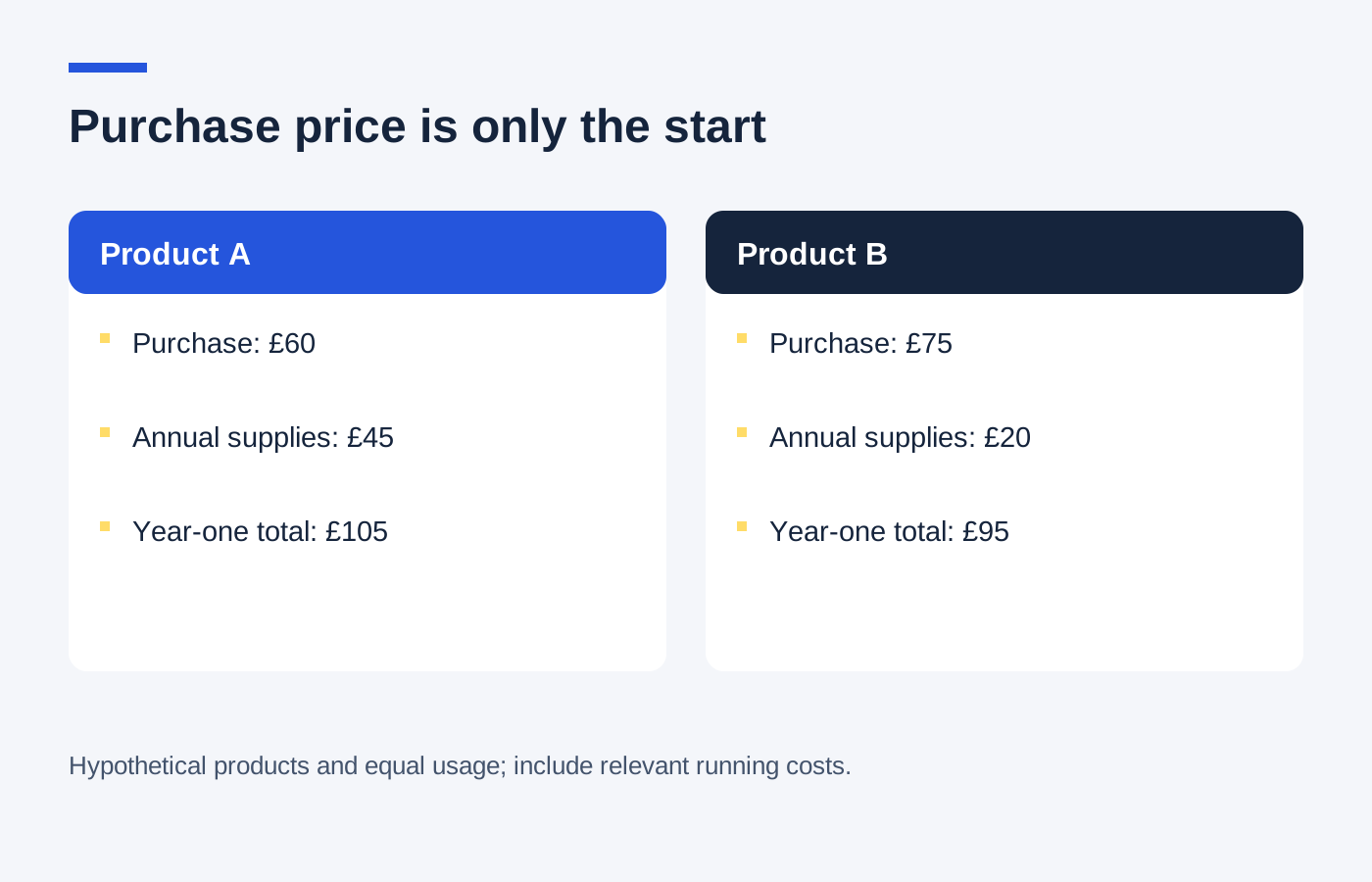
Start with what the item needs to work: ink, filters, bags, batteries, cleaning supplies or a paid service. Check the exact part number and the manufacturer's replacement guidance. A generic search for a similar-looking refill can produce a misleading price if it does not fit the model.
Add any essential accessory omitted from the box. A product that needs a separate charger, mounting kit or connection cable should be compared at its usable price. Installation and disposal of an old appliance can also matter when they are part of the purchase you need.
Estimate energy from the right information
For a device drawing a steady load, energy use in kilowatt-hours can be estimated by multiplying power in kilowatts by hours of operation. Multiply that result by your electricity unit rate to estimate the energy charge. National Energy Action explains this relationship in its appliance-cost guidance.
As a deliberately hypothetical example, a 40-watt lamp used for four hours a day consumes 0.16kWh daily: 0.04kW multiplied by four. At an illustrative rate of 25p per kWh, that is 4p a day, or £14.60 over 365 days. Use your actual tariff rather than treating 25p as a current national rate.
Not every appliance runs continuously at its rated power. A thermostat-controlled device cycles, and a washing machine uses different amounts on different programmes. Use the manufacturer's consumption information or energy label on a comparable basis where available. Do not calculate a fridge's yearly cost by assuming its maximum wattage runs every hour.
Compare alternatives doing the same job
A lower-powered product is not automatically cheaper for a task if it needs to run longer. Compare the same useful output: a wash programme, a quantity of printing or a room condition, as appropriate. Keep capacity and performance requirements consistent so the cheaper estimate does not describe less work.
Suppose two fictional products cost £70 and £90. If the £90 option genuinely saves £8 per year under your use, it takes two and a half years to recover the £20 purchase difference through that saving alone. If you expect only one year of use, the higher initial price is not recovered on those figures.
Treat consumables as a repeating basket
For a printer, look at compatible cartridge prices and the stated yield, while recognising that actual output depends on what you print. For a vacuum, check bags and filters. For a water filter, compare the required cartridge type and replacement schedule instead of the appearance of the jug.
An example £15 filter replaced four times a year costs £60 annually. A £10 reduction on the initial appliance is small beside that recurring amount. The more expensive appliance is not necessarily better, but the comparison should make the £60 visible.
Use a range when behaviour is uncertain
Estimate a low-use and a higher-use scenario if you cannot predict frequency accurately. Keep electricity rates, consumable prices and replacement intervals explicit so the calculation can be updated. Avoid presenting a precise lifetime saving when several assumptions are unknown.
Check whether replacement parts are available and whether the product can be maintained in the way you expect. A low-cost item that becomes unusable when a basic part fails may be less suitable than one with a clear repair route. Do not assign a guaranteed lifespan without evidence.
Choose using the purchase price and the likely costs you can establish. The result may favour the discounted model, a different product or keeping what you already own. A sale is most useful when it lowers the cost of the whole job, rather than only the first payment.