Write out more than the first payment
Record the introductory price, the later price, delivery charges and delivery frequency. Check whether the subscription renews automatically and whether there is a minimum number of orders. A first-box saving is difficult to value until the later obligations are clear.
Imagine a fictional product that costs £18 for a one-off order. A subscription charges £12 for the first delivery and £17 for each of the next five, with identical delivery costs. Six deliveries would cost £97, compared with £108 for six one-off purchases. The potential saving is £11 across those six deliveries, not £6 on every delivery.
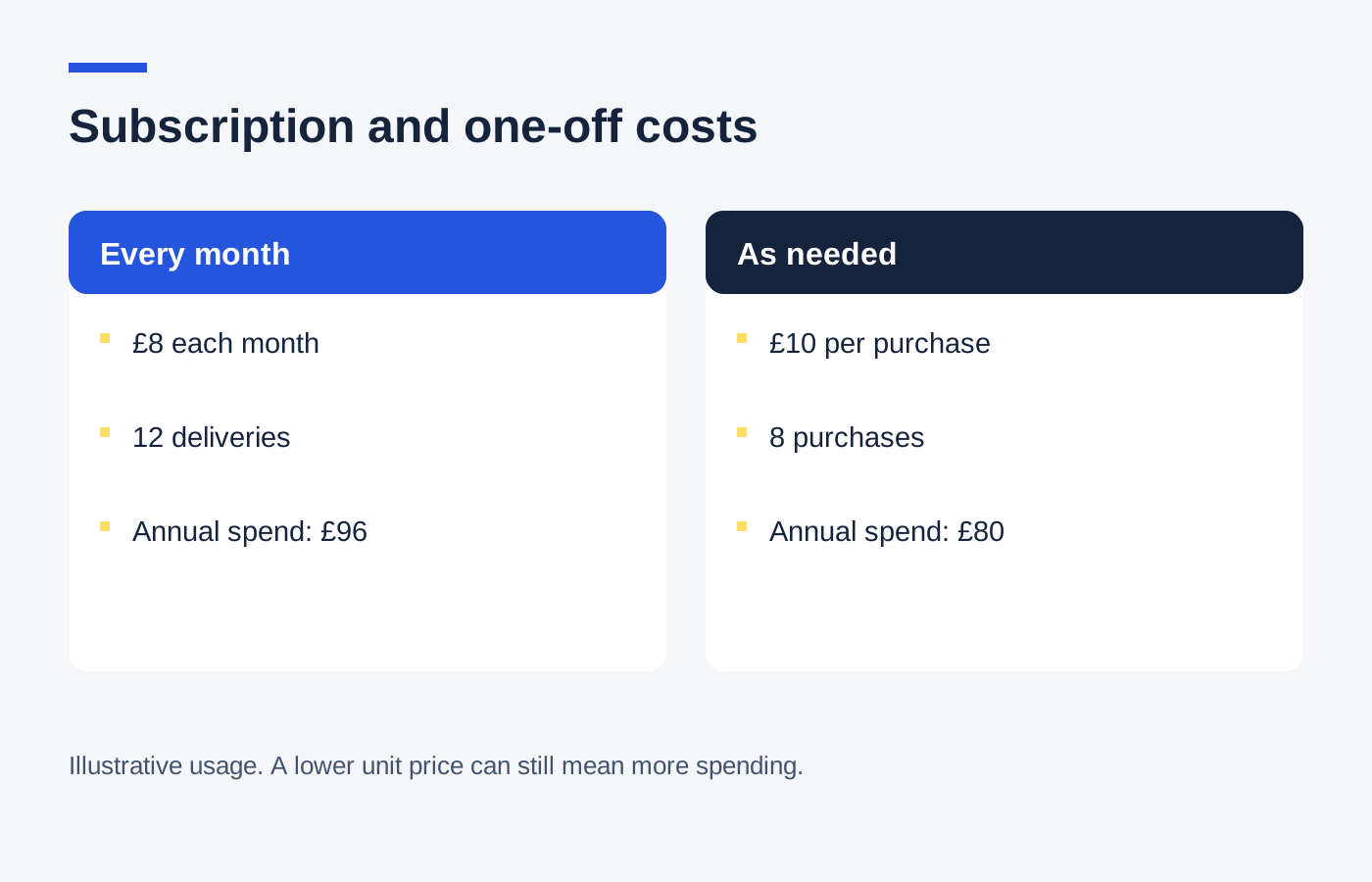
That comparison assumes you need all six. If you would normally buy four units during the same period, four one-off purchases cost £72. Receiving six on the subscription schedule costs £25 more and leaves extra stock. A lower per-unit price has not reduced the spending needed for your actual use.
Match the interval to consumption
Estimate how long one delivery lasts using your own recent use. A household product may run out faster during holidays or slower when people are away. Choose an interval with enough flexibility to avoid both emergency purchases and a growing cupboard of unopened stock.
Check whether you can change quantity, skip a delivery or pause the subscription, and how far ahead the request must be made. Do not assume a change takes effect on an order already being prepared. Keep the next processing date visible rather than relying only on the arrival date.
Read the cancellation route before joining
Find the account control or contact process used to cancel. Establish whether cancellation stops future orders immediately or after a stated commitment. Save the confirmation when you make a change, and check that the next scheduled order reflects it.
Removing an app, deleting a payment card from a wallet or ignoring a delivery email is not a clear cancellation instruction. Follow the retailer's process. If you cannot find understandable terms for ending the arrangement, resolve that before signing up rather than assuming it will be simple later.
Check the product and price flexibility
A subscription may allow substitutions, flavour changes or a different pack size. Read whether the seller can change products or prices and how it communicates that. If you need one exact formulation or size, a loosely specified recurring box may be unsuitable even at a low introductory price.
Compare the renewal price with current one-off alternatives periodically. A subscription that was competitive at the start may become less attractive when another retailer changes its pack size or normal price. Familiarity and convenience can have value, but they should be chosen knowingly.
Keep a small stock and payment record
Note the next order date, quantity due and stock already at home. Review those three facts before the change deadline. This takes less effort than trying to return repeated deliveries or find space for items that arrived faster than expected.
For budgeting, count the actual recurring payment rather than only the discount percentage. A hypothetical 15% reduction on a product you would otherwise buy less frequently can still increase monthly spending. The schedule and quantity belong in the same calculation as the price.
Choose a subscription when you use the product predictably, understand the terms and value the convenience at the renewal price. Use one-off orders when your consumption varies or you are still trying the product. You can revisit the decision after learning how much you actually need.